Middle School GPA Calculator
Our Middle School GPA Calculator helps students calculate their GPA accurately, whether your school uses credit hours or not. Track your grades, monitor progress, and plan for high school success.
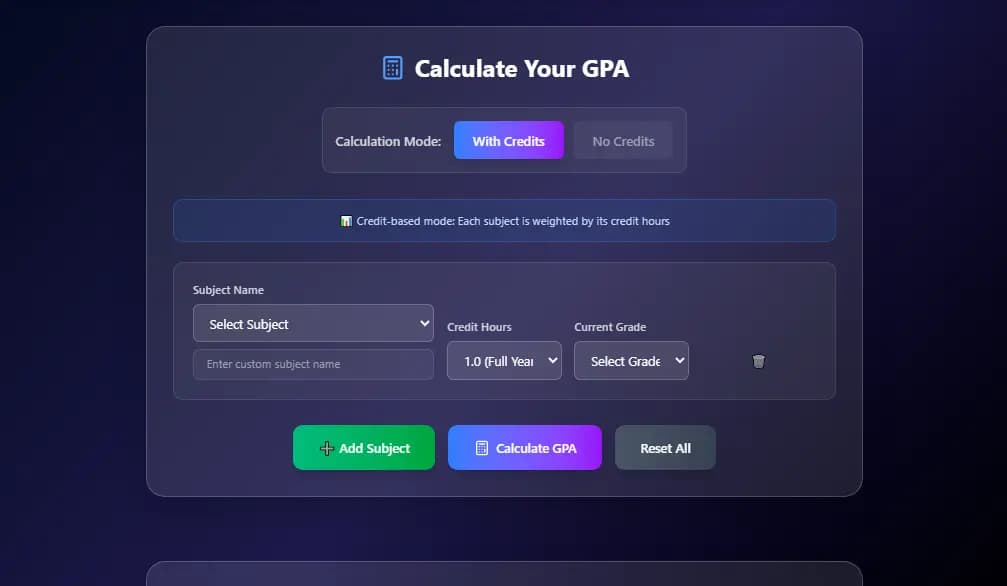
Calculate Your GPA
📊 Credit-based mode: Each subject is weighted by its credit hours
Start Tracking Your Academic Success
Use our middle school GPA calculator without credits and with credits to monitor your progress, set academic goals, and build the foundation for high school success. Your academic journey starts here!
Track Progress
Monitor your GPA throughout the semester
Set Goals
Establish realistic academic targets
Prepare for High School
Build strong academic foundations
Tracking your academic performance has never been easier with the Middle School GPA Calculator. Designed specifically for middle school students, this tool helps you calculate your Grade Point Average accurately and efficiently, giving you clear insights into your progress. Whether your school uses credit hours or not, the Middle Schools GPA Calculator for No-Credit Courses allows you to compute your GPA quickly without worrying about complex calculations. By entering your subjects and grades, you can instantly see your GPA, monitor trends across semesters, and set realistic academic goals. This calculator is perfect for students preparing for high school, parents wanting to track progress, and teachers supporting student success. With this tool, understanding your academic standing becomes simple, reliable, and actionable, ensuring every student can stay on top of their performance and plan effectively for future academic achievements.
Understanding GPA Fundamentals for Middle School Success
Grade Point Average (GPA) serves as a standardized measurement system that converts your letter grades into a numerical format, typically using a 4.0 scale. This system, as monitored by the National Center for Education Statistics (NCES), allows schools, parents, and students to quickly assess academic performance across multiple subjects and semesters.
During middle school years (grades 6-8), maintaining a strong GPA becomes increasingly important as it establishes the academic foundation for high school success. Students who develop effective study habits and achieve consistent grades in middle school are better prepared for the rigorous coursework they'll encounter in high school Advanced Placement (AP) courses, following U.S. Department of Education guidelines, International Baccalaureate (IB) programs, and college preparatory classes.
Why Middle School GPA Matters More Than You Think
- High School Placement: Many schools use middle school GPA to determine placement in honors, Advanced Placement, or remedial courses
- Study Habit Formation: Middle school is the optimal time to develop organizational skills, time management, and effective study strategies
- Academic Confidence: Success in middle school builds self-efficacy and confidence for tackling challenging high school coursework
- College Preparation: Early exposure to GPA concepts helps students understand college admission requirements and expectations, a key focus of the Harvard Graduate School of Education.
- Scholarship Opportunities: Some merit-based scholarships consider cumulative academic performance starting from middle school
Understanding the GPA system early empowers students to make informed decisions about their academic priorities, course selections, and study strategies. It also helps parents and teachers identify areas where students may need additional support or enrichment opportunities.
How to Use the Middle School GPA Calculator
- Add the subjects you are studying and choose the grade for each one.
- Enter the credit hours for every subject if your school uses a credit system.
- Click Calculate GPA to see your result instantly.
- Review your GPA regularly across semesters to track academic progress.
- Use your results to set realistic goals and improve future performance.
Middle School GPA Calculator for No-Credit Courses
- Enter your subjects and grades only (no credits needed).
- The calculator automatically averages the grades.
- Get your GPA instantly.
- Ideal for schools without credit hour systems.
- Track overall performance easily and efficiently.
Middle School Grade Scale & Point Values
| Letter Grade | Grade Points | Percentage Range | Performance Description |
|---|---|---|---|
| A+ | 4.0 | 97-100% | Exceptional mastery |
| A | 4.0 | 93-96% | Superior performance |
| A- | 3.7 | 90-92% | Very strong grasp |
| B+ | 3.3 | 87-89% | Above average |
| B | 3.0 | 83-86% | Good understanding |
| B- | 2.7 | 80-82% | Satisfactory work |
| C+ | 2.3 | 77-79% | Adequate grasp |
| C | 2.0 | 73-76% | Basic understanding |
| C- | 1.7 | 70-72% | Below average |
| D+ | 1.3 | 67-69% | Minimal understanding |
| D | 1.0 | 65-66% | Poor performance |
| F | 0.0 | Below 65% | Failing grade |
Important Note: Grade scales may vary between school districts. Some schools use different percentage ranges or include additional grades like A+ or D-. Always check with your school's guidance office for your specific grading scale.
Step-by-Step GPA Calculation Guide
The Standard 4.0 GPA Calculation Method
- Convert Letter Grades: Transform each letter grade into grade points using the standard scale (A=4.0, B=3.0, C=2.0, D=1.0, F=0.0). Plus grades typically add 0.3 points (B+ = 3.3) while minus grades subtract 0.3 points (B- = 2.7).
- Account for Credit Hours: Multiply each grade point by the course's credit value. Most middle school courses are worth 1.0 credit, but some intensive programs may assign different credit values to advanced or extended courses.
- Calculate Quality Points: Add all quality points together to determine your total earned points across all courses taken during the calculation period.
- Determine Total Credits: Sum all credit hours attempted, including both passed and failed courses, as failed courses still count toward your total credit hours.
- Final Calculation: Divide total quality points by total credit hours to arrive at your GPA, typically rounded to two decimal places.
Detailed GPA Calculation Example
Let's calculate Sarah's 8th grade GPA using her semester grades:
| Course | Grade | Grade Points | Credits | Quality Points |
|---|---|---|---|---|
| English Language Arts | A- | 3.7 | 1.0 | 3.7 |
| Algebra I | B+ | 3.3 | 1.0 | 3.3 |
| Earth Science | A | 4.0 | 1.0 | 4.0 |
| World History | B | 3.0 | 1.0 | 3.0 |
| Spanish I | A- | 3.7 | 1.0 | 3.7 |
| Physical Education | A | 4.0 | 0.5 | 2.0 |
| TOTALS | — | — | 5.5 | 19.7 |
GPA Calculation: 19.7 quality points ÷ 5.5 credits = 3.58 GPA
Important Calculation Considerations
- Weighted vs. Unweighted: Some schools add extra points (0.5-1.0) for honors or advanced courses, creating weighted GPAs that may exceed 4.0
- Semester vs. Cumulative: GPA can be calculated for individual semesters or cumulatively across all completed coursework
- Course Exclusions: Some schools exclude certain electives, pass/fail courses, or repeated courses from GPA calculations
- Grading Periods: Schools may use different grading periods (quarters, trimesters, semesters) which affects when GPA is calculated and updated
Proven Strategies to Improve Your Middle School GPA
Set SMART Goals
Create specific, measurable, achievable, relevant, and time-bound academic targets. For example, "For example, you might set a goal like this: “I will raise my math grade from C+ to B by completing every homework assignment and attending tutoring sessions twice a week for the next month.” Check your progress each week so you can stay motivated and adjust your study plan if necessary." Track progress weekly to stay motivated and adjust strategies as needed.
Master Time Management
Use digital planners, physical calendars, or apps to schedule study time, assignment deadlines, and extracurricular activities. Allocate specific time blocks for each subject, include break times, and stick to your schedule consistently. Effective time management prevents last-minute cramming and reduces academic stress.
Build Study Communities
Form study groups with classmates who share similar academic goals and commitment levels. Meet regularly to review material, quiz each other, and explain difficult concepts. Peer teaching reinforces learning while creating accountability partnerships that encourage consistent study habits.
Use Active Learning Techniques
Replace passive reading with active strategies: summarize information in your own words, create mind maps and visual organizers, teach concepts to family members or study partners, ask questions while studying, and connect new information to previously learned material. Active learning improves retention and understanding significantly.
Stay Systematically Organized
Maintain separate folders and notebooks for each subject, use color-coding systems, keep assignment trackers updated, organize study spaces to minimize distractions, and develop consistent filing systems for handouts and notes. Organization reduces stress and saves valuable study time.
Seek Support Proactively
Communicate with teachers during office hours or after class when you first notice confusion, utilize school tutoring programs and peer assistance, ask parents or siblings for help with homework review, and consider professional tutoring for persistent challenges. Early intervention prevents small problems from becoming major academic issues.
Advanced Study Techniques for GPA Success
Evidence-Based Learning Methods
- Spaced Repetition: Review material at increasing intervals to improve long-term retention
- Interleaving: Mix different types of problems or subjects within study sessions
- Elaborative Interrogation:Improve your understanding by asking “why” and “how” questions about the material while studying.
- Self-Explanation: Explain concepts and problem-solving steps to yourself
Digital Study Tools
- Flashcard Apps: Use spaced repetition software like Anki or Quizlet
- Mind Mapping: Create visual connections between concepts
- Pomodoro Technique: Study in focused 25-minute intervals with breaks
- Progress Tracking: Monitor study time and comprehension levels
Subject-Specific Strategies
- Mathematics: Practice problems daily, focus on understanding steps, use visual representations
- English: Read actively, take notes while reading, practice writing regularly
- Science: Connect concepts to real-world examples, use laboratory observations
- Social Studies: Create timelines, connect historical events, analyze cause and effect
Test Preparation Techniques
- Practice Testing: Take practice quizzes regularly to identify knowledge gaps
- Review Sessions: Schedule dedicated review time before major assessments
- Study Guides: Create comprehensive study guides that summarize key concepts
- Sleep and Nutrition: Maintain healthy sleep patterns and proper nutrition for optimal cognitive performance
Essential Resources for Parents Supporting Middle School Success
How Parents Can Support GPA Improvement
Academic Support Strategies
- • Establish consistent homework routines and designated study spaces
- • Monitor progress through parent portals and regular teacher communication
- • Provide necessary school supplies and learning resources
- • Celebrate academic achievements and improvements, regardless of size
- • Arrange tutoring or additional support when needed
Emotional and Motivational Support
- • Maintain open communication about academic challenges and successes
- • Help students develop realistic academic goals and expectations
- • Teach stress management and coping strategies for academic pressure
- • Model lifelong learning behaviors and positive attitudes toward education
- • Maintain a healthy balance between academic goals and students’ social and emotional well-being.
Warning Signs That May Indicate Academic Struggles
Academic Red Flags
- • Declining grades across multiple subjects
- • Missing or incomplete assignments
- • Difficulty understanding basic concepts
- • Poor performance on tests despite studying
Behavioral Changes
- • Increased resistance to homework time
- • Avoiding discussions about school
- • Changes in sleep patterns or appetite
- • Loss of interest in previously enjoyed activities
Social and Emotional Indicators
- • Increased anxiety around school topics
- • Social withdrawal or isolation
- • Frequent complaints of illness on school days
- • Expressions of feeling overwhelmed or hopeless
Transitioning from Middle School to High School Success
How Middle School GPA Impacts High School Opportunities
Your middle school academic performance serves as a foundation for high school course placement and opportunities. High schools use middle school transcripts to determine eligibility for advanced courses, specialized programs, and academic tracks.
High School Course Placement Factors
- Honors Eligibility: Many schools require a 3.5+ GPA for honors course consideration
- Advanced Placement (AP): Strong middle school performance indicates readiness for college-level coursework
- Dual Enrollment: Some programs allow qualified students to earn college credit during high school
- Specialized Programs: STEM academies, arts programs, and career pathways often have GPA requirements
Long-term Academic Benefits
- Study Skills Foundation: Effective habits developed in middle school transfer to high school
- Academic Confidence: Success builds self-efficacy for tackling challenging coursework
- Teacher Relationships: Strong academic performance helps build positive relationships with educators
- College Preparation: Early exposure to GPA concepts prepares students for college admission processes
Conclusion: Take Control of Your Middle Schools GPA Today
Understanding and tracking your middle schools GPA is one of the smartest steps you can take toward long-term academic success. By using a reliable middle school GPA calculator, students can clearly see how their grades impact overall performance, identify areas for improvement, and develop strong study habits early on. Parents also benefit by gaining insight into academic progress and providing timely support when it matters most.
Middle schools are the foundation for high school readiness, and consistent GPA monitoring helps build confidence, discipline, and goal-setting skills that last beyond the classroom. Whether you’re aiming to improve grades, prepare for advanced courses, or simply stay organized, calculating your GPA regularly keeps you informed and motivated.
Start using our free middle school GPA calculator today to track progress accurately, set achievable academic goals, and build a strong path toward future success. Small improvements now can make a big difference later.