Looking for an easy and accurate way to calculate your semester grades? Our SGPA Calculator is designed for students from top Indian universities like KTU, AKTU, JNTUH, SRM, SPPU, JNTU, and many others. Whether you want to compute your SGPA for a single semester, convert it to percentage, or plan your academic progress, this free online tool gives instant, precise results.
Simply select your grade scale, enter your subject grades and credit hours, and get your Semester Grade Point Average (SGPA) in seconds. Perfect for engineering, medical, and management students, our calculator helps you track performance, prepare for placements, and stay on top of scholarship requirements.
What is SGPA? Understanding Semester Grade Point Average
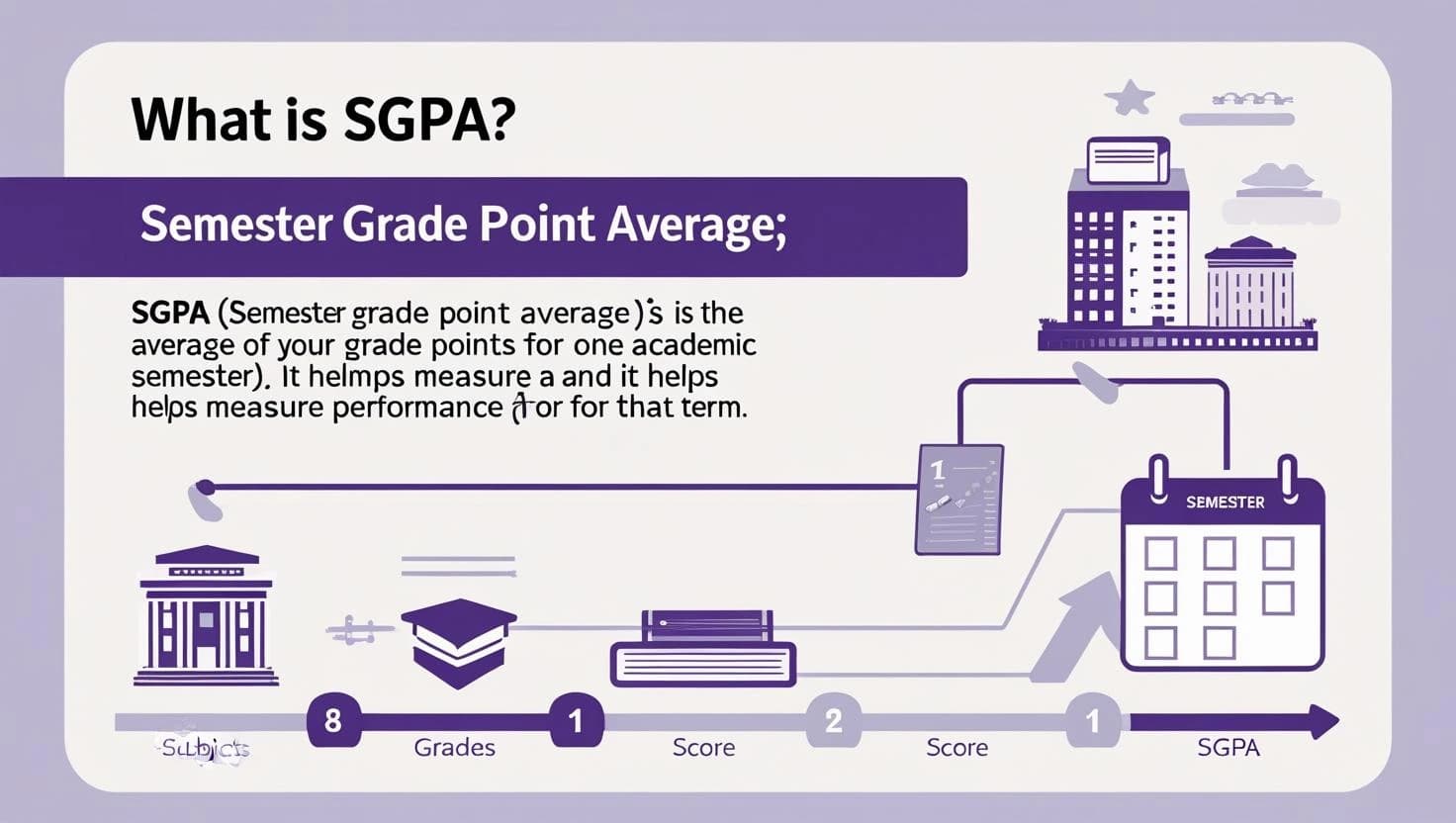
SGPA (Semester Grade Point Average) is a numerical representation of a student’s academic performance for a single semester. Unlike traditional percentage systems, SGPA provides a standardized way to evaluate performance across different subjects, taking into account both grades and credit hours.
SGPA is a weighted average, meaning that subjects with higher credit hours have a greater impact on your overall semester performance. This ensures an accurate reflection of your academic achievements, whether you are studying at KTU, AKTU, JNTUH, SRM, SPPU, JNTU, or other Indian universities.
Key Differences: SGPA vs GPA vs CGPA
- SGPA (Semester GPA): Performance evaluation for one semester only
- GPA (Grade Point Average): Can refer to semester or cumulative performance
- CGPA (Cumulative GPA): Overall academic performance across all completed semesters
Understanding these distinctions is crucial for academic planning and career preparation. For a more detailed breakdown, read our guide on the difference between SGPA and CGPA.
How to Use Our SGPA Calculator
Select Grade Scale
Choose your institution's grading system:
Select Grade
Pick the grade you received for each course from the dropdown menu (A, B, C, etc.).
Enter Credits
Input the credit hours assigned to each subject as per your course structure.
Enter Subject
Add the subject name for easy identification and click calculate to get your SGPA instantly.
The calculator automatically processes this information and displays your Semester Grade Point Average instantly, eliminating manual computation errors.

Importance of SGPA in Academic Life
Universities worldwide have adopted the SGPA system for several compelling reasons:
Academic Progress Tracking
SGPA provides a clear, semester-wise breakdown of your academic journey. This granular view helps identify improvement patterns or areas needing attention.
Scholarship and Financial Aid
Many scholarship programs use SGPA thresholds as eligibility criteria. Maintaining consistent high SGPA scores improves your chances significantly.
Placement Opportunities
Recruiters often specify minimum SGPA requirements for campus placements. A strong semester GPA demonstrates consistency to potential employers.
Higher Education Applications
Graduate schools evaluate SGPA trends to assess applicant potential and academic stability for admission decisions.
Understanding Grade Points and Credit Hours
Grade points represent the numerical value assigned to the letter grade you receive in a course. In most grading systems, grades are converted to a 10-point or 4-point scale. For example, an 'A' grade typically equals 10 points, 'B' equals 8 points, and so on.
Credit hours reflect the weightage or importance of each course in your curriculum. Courses with more classroom hours, practical sessions, or complexity carry higher credit hours. A mathematics course might have 4 credit hours while a physical education class might have only 1 credit hour.
The relationship between grade points and credit hours determines your SGPA. Courses with higher credit hours have a greater impact on your overall semester performance. Understanding this connection helps you prioritize subjects strategically throughout the semester.
Grade Points
Numerical value of your letter grade (e.g., A=10, B=8)
Credit Hours
Course weightage based on complexity and duration
SGPA Calculation Formula: Step-by-Step Guide
SGPA = (Sum of (Grade Point × Credit Hours)) ÷ (Total Credit Hours)
Understanding the Components
- Grade Point: Numerical value assigned to letter grades (O=10, A+=9, A=8, etc.)
- Credit Hours: Academic weight of each subject (typically 1-4 credits)
- Total Credit Hours: Sum of credit hours for all subjects in the semester
Standard 10-Point Grading Scale
| Grade | Grade Point | Performance Level |
|---|---|---|
| O | 10 | Outstanding |
| A+ | 9 | Excellent |
| A | 8 | Very Good |
| B+ | 7 | Good |
| B | 6 | Above Average |
| C | 5 | Average |
| P | 4 | Pass |
| F | 0 | Fail |
Calculating SGPA Manually: A Step-by-Step Guide
List All Courses
Write down all the subjects you've studied in the semester with their respective grades and credit hours. Organize this information in a table format for clarity.
Convert Grades to Points
Transform each letter grade into its numerical equivalent using your institution's grading scale. Ensure you're using the correct conversion chart provided by your university.
Multiply Grade Points by Credit Hours
For each course, multiply the grade point by its credit hours. This gives you the weighted grade points for that particular subject.
Sum the Products
Add all the weighted grade points together. This total represents your cumulative performance across all courses for the semester.
Sum Total Credit Hours
Calculate the total credit hours by adding the credit hours of all courses you've completed in the semester.
Divide to Get SGPA
Divide the sum of weighted grade points by the total credit hours. The resulting number is your SGPA. Round it to two decimal places for standard reporting.
Formula:
SGPA = (Sum of Grade Points × Credit Hours) / Total Credit Hours
SGPA Calculation Example: Practical Demonstration
Let's work through a detailed example to illustrate the SGPA calculation process:
Sample Semester Subjects
| Subject | Grade | Grade Point | Credit Hours | Points Earned |
|---|---|---|---|---|
| Mathematics | A+ | 9 | 4 | 36 |
| Physics | A | 8 | 3 | 24 |
| Chemistry | A+ | 9 | 3 | 27 |
| English | B+ | 7 | 2 | 14 |
| Lab Work | A | 8 | 2 | 16 |
Step-by-Step Calculation
- Calculate Points Earned: Grade Point × Credit Hours for each subject
- Total Points Earned: 36 + 24 + 27 + 14 + 16 = 117
- Total Credit Hours: 4 + 3 + 3 + 2 + 2 = 14
- SGPA: 117 ÷ 14 = 8.36
Result Interpretation: An SGPA of 8.36 falls in the "Very Good" category, indicating strong academic performance.
SGPA to Percentage Conversion
Converting SGPA to percentage helps students understand their performance in familiar terms. The most commonly used formula is:
Percentage = SGPA × 9.5
For detailed conversion and more tools, check out our SGPA to Percentage Calculator.
Conversion Examples
| SGPA | Percentage | Performance Level |
|---|---|---|
| 10.0 | 95% | Outstanding |
| 9.0 | 85.5% | Excellent |
| 8.5 | 80.75% | Very Good |
| 8.0 | 76% | Very Good |
| 7.5 | 71.25% | Good |
| 7.0 | 66.5% | Good |
Note: Different universities may use varying conversion formulas. Always verify with your institution's specific guidelines.
Why Use Our Online SGPA Calculator?
Manual SGPA calculation can be time-consuming and error-prone. Our free SGPA calculator offers numerous advantages:
Instant & Accurate Results
Get your semester GPA within seconds, eliminating calculation errors and saving valuable study time.
Multiple Subjects Support
Handle unlimited subjects with different credit hours and grading scales effortlessly.
Flexible Grading Systems
Supports various grading scales including 10-point, 4-point, and custom university systems.
Mobile-Friendly Design
Calculate your SGPA anywhere, anytime using your smartphone, tablet, or computer.
Who Should Use This SGPA Calculator?
Our calculator serves diverse academic communities across various educational levels and institutions:
Engineering Students
Students from prestigious institutions like AKTU, VTU, JNTU, NITs, and IITs can quickly verify their semester performance and plan academic strategies. Engineering programs typically have complex credit structures that our calculator handles effortlessly.
- Computer Science and IT students
- Mechanical, Civil, and Electrical engineering students
- Biotechnology and Chemical engineering students
Medical Students
MBBS, BDS, Pharmacy, and other medical program students benefit from accurate SGPA tracking for internship and residency applications. Medical education requires precise academic monitoring.
- Medical and dental students
- Pharmacy and nursing students
- Allied health science students
Academic Professionals
Educational advisors, teachers, and academic counselors use our tool to quickly assess student performance and provide targeted guidance for academic improvement.
- Academic advisors and counselors
- University faculty and professors
- Educational consultants
Parents & Guardians
Stay informed about your child's academic progress and identify areas needing additional support or celebration.
Scholarship Applicants
Accurately calculate SGPA for scholarship applications and verify eligibility requirements for various funding opportunities.
SGPA in Indian and International Universities
Indian University Systems
Major Indian universities have adopted standardized SGPA systems to ensure consistent evaluation across institutions:
AKTU (Dr. A.P.J. Abdul Kalam Technical University)
Uses 10-point scale with semester-wise evaluation for all technical programs across Uttar Pradesh.
VTU (Visvesvaraya Technological University)
Implements 10-point scale with letter grades for engineering colleges in Karnataka.
JNTU (Jawaharlal Nehru Technological University)
Features 10-point system with specific grade boundaries for Telangana and Andhra Pradesh.
Mumbai University
Employs 10-point scale with semester-wise evaluation across various faculties.
IITs and NITs
Maintain standardized 10-point SGPA system across all premier technical institutions.
Central Universities
Most follow UGC guidelines with 10-point grading system for consistent evaluation.
International Grading Systems
Understanding global variations helps with international applications and academic mobility:
| Country/Region | Scale | Grade System | Notes |
|---|---|---|---|
| US/Canada | 4.0 | A=4.0, B=3.0, C=2.0, D=1.0 | Most common in North America |
| UK | Percentage | First Class (70%+), Upper Second (60-69%) | Classification system |
| European ECTS | Letter grades | A (90-100%), B (80-89%), C (70-79%) | European Credit Transfer System |
| Australia | 7.0 | HD=7, D=6, CR=5, P=4 | High Distinction system |
Related Academic Tools
Enhance your academic planning with our comprehensive suite of calculation tools:
Tips to Improve Your SGPA: Academic Success Strategies
Prioritize High-Credit Subjects
Focus extra effort on subjects with higher credit hours, as they significantly impact your overall SGPA.
Develop Consistent Study Habits
Regular study schedules prevent last-minute cramming and improve retention rates.
Set Realistic SGPA Targets
Establish achievable semester goals and track progress regularly using our calculator.
Form Study Groups
Collaborative learning enhances understanding and provides different perspectives on complex topics.
Practice Regular Assessment
Take mock tests and practice exams to identify weak areas before official evaluations.
Seek Help Early
Don't hesitate to approach professors, teaching assistants, or tutors when facing difficulties.
Common Mistakes Students Make in SGPA Calculation
Avoid these frequent errors that can lead to incorrect SGPA calculations and academic misunderstandings:
Confusing SGPA with CGPA
Mistake: Using SGPA and CGPA interchangeably or thinking they represent the same value.
Reality: SGPA represents single-semester performance, while CGPA covers multiple semesters.
Solution: Always specify whether you're discussing semester-specific or cumulative performance.
Ignoring Credit Hours
Mistake: Treating all subjects equally regardless of their credit hours.
Impact: This leads to significantly incorrect SGPA calculations and misunderstanding of academic performance.
Solution: Always multiply grade points by credit hours before calculating the weighted average.
Using Incorrect Grade Scales
Mistake: Applying grade point values from one university system to another.
Example: Using a 4-point scale when your university follows a 10-point system.
Solution: Always verify your institution's specific grading system and scale before calculations.
Simple Averaging Mistake
Mistake: Calculating SGPA as a simple arithmetic mean of all grades.
Wrong Formula: SGPA ≠ (Grade1 + Grade2 + Grade3...) ÷ Number of Subjects
Correct Approach: Use weighted average considering credit hours for accurate results.
Pro Tip: Our SGPA calculator automatically handles all these complexities, ensuring you get accurate results without worrying about common calculation errors.
Conclusion
Understanding and accurately calculating your SGPA is fundamental to academic success. Our comprehensive guide has covered everything from basic concepts to practical applications, ensuring you have the knowledge needed to excel in your academic journey.
The SGPA calculator online tool eliminates calculation errors and saves valuable time, allowing you to focus on what matters most—your studies. Whether you're an engineering student at a prestigious NIT, a medical student preparing for competitive exams, or a parent monitoring your child's progress, our free calculator provides the accuracy and convenience you need.
Start using our SGPA calculator today and take control of your academic future. With instant results, mobile-friendly design, and support for multiple grading systems, achieving your educational goals has never been more manageable. Calculate your semester GPA now and unlock your full academic potential!