This SGPA to CGPA Calculator helps students quickly convert semester-wise SGPA into an accurate cumulative CGPA using both simple average and credit-weighted methods. Designed to support multiple grading systems—including 10-point, 4-point, and 5-point scales—the calculator follows standard university calculation practices to ensure reliable results. Whether you are tracking academic progress, checking eligibility for scholarships, or preparing for jobs or higher studies, this tool provides instant and precise CGPA calculations with full transparency.
Understanding SGPA and CGPA
Understanding your academic performance is crucial for every student pursuing higher education in today's competitive landscape. Two key metrics that determine your academic standing are SGPA (Semester Grade Point Average) and CGPA (Cumulative Grade Point Average). These numerical indicators serve as standardized measures that universities, employers, and graduate schools use to evaluate academic excellence.
This comprehensive guide will help you understand how to calculate, convert, and strategically use these important academic indicators. Whether you're a freshman just starting your academic journey or a senior preparing for graduation, mastering SGPA to CGPA conversion is essential for making informed decisions about your educational path.
The ability to accurately calculate and interpret your CGPA can significantly impact your academic and career opportunities. From scholarship applications to job interviews, your CGPA often serves as the first screening criterion. Understanding these calculations empowers you to take control of your academic trajectory and make strategic choices about course selection, study priorities, and career planning.Track your sgpa through our Sgpa Calculator.
SGPA (Semester Grade Point Average)
Represents your academic performance in a specific semester. Calculated by dividing total credit points earned by total credits attempted in that semester.
Key Features: Reflects short-term performance, helps identify semester-wise trends, useful for immediate academic interventions, and determines semester-specific honors.
CGPA (Cumulative Grade Point Average)
Overall academic performance indicator considering all semesters completed. Provides a comprehensive view of your academic progress throughout your degree.
Key Features: Reflects long-term consistency, used for graduation honors, essential for job applications, and determines overall academic standing.
Who Should Use This SGPA to CGPA Calculator?
This SGPA to CGPA Calculator is designed for students across different education systems who want accurate, fast, and reliable academic performance evaluation. Whether you are tracking progress, meeting eligibility criteria, or planning future goals, this tool adapts to multiple grading scales and university policies.
Engineering & Medical Students
Engineering and medical programs often follow credit-heavy and semester-based structures, where each subject carries different weightage. This calculator helps such students accurately convert semester-wise SGPA into cumulative CGPA using credit-weighted methods, which is crucial for merit lists, internships, and postgraduate admissions.
Indian University Students (10-Point Scale)
Students enrolled in Indian universities that use the 10-point grading system can easily calculate CGPA from multiple semesters. The calculator supports both simple average and credit-based calculations, making it suitable for institutions where semester credit loads may vary.
US & Canada Students (4-Point Scale)
For students studying in the US or Canada, where the 4.0 GPA system is standard, this calculator ensures accurate CGPA calculation based on credit hours, aligning with university transcripts and international academic standards.
Pakistani University Students (HEC-Affiliated)
Students from HEC-recognized universities in Pakistan can use this calculator to track cumulative academic performance semester by semester. Since most Pakistani universities follow a credit-hour GPA system, the weighted CGPA method ensures precise results.
Students Applying for Scholarships, Jobs, or Higher Studies
Many scholarships, job applications, and graduate programs require a minimum CGPA cutoff. This calculator helps students:
- Monitor eligibility requirements
- Prepare academic documents confidently
- Convert grades accurately for applications and interviews
SGPA to CGPA Calculation in Different Universities
Grading and CGPA calculation methods vary across universities and countries. Understanding these differences is essential for accurate evaluation, transfers, and official applications.
Indian Universities (AKTU, VTU, Anna University)
Most Indian technical universities such as AKTU, VTU, and Anna University follow a 10-point grading system with credit-weighted calculations. CGPA is typically calculated by multiplying each semester’s SGPA with its total credits, then dividing by the overall credits completed. This calculator aligns with these standard university practices.
Pakistani Universities (HEC-Affiliated)
HEC-affiliated universities generally calculate CGPA using credit hours and grade points across semesters. While policies on failed or repeated courses may differ, the core calculation remains credit-weighted, which this tool fully supports.
US Universities (Credit Hours & GPA Rules)
US universities calculate CGPA on a 4-point scale, heavily dependent on credit hours per course. Each course grade contributes proportionally to the overall GPA. This calculator mirrors that system, making it suitable for transcript verification and academic planning.
Private Universities (Grade Replacement Policies)
Many private universities allow grade replacement when a student retakes a failed or low-scoring course. In such cases, either the latest grade or the highest grade is considered for CGPA calculation. This calculator allows flexible semester inputs, making it useful even when institutional policies differ.
Why Convert SGPA to CGPA?
Converting SGPA to CGPA is not just a mathematical exercise—it's a strategic necessity in today's academic and professional environment. This conversion helps you understand your overall academic trajectory and make informed decisions about your future. Many students underestimate the importance of regular CGPA monitoring, only to discover later that they've missed crucial opportunities due to inadequate academic planning.
Academic Benefits
- Academic Monitoring: Track overall progress across semesters and identify performance patterns that might not be obvious from individual SGPAs
- Eligibility Requirements: Meet minimum CGPA thresholds for scholarships, honors programs, research opportunities, and academic societies
- University Transfers: Calculate equivalent grades when transferring between institutions with different grading systems
- Strategic Planning: Make informed decisions about course loads, difficulty levels, and graduation timelines
Career Advantages
- Graduate Applications: Present a comprehensive academic record for master's and doctoral program admissions
- Career Opportunities: Demonstrate consistent academic performance to potential employers and meet recruitment criteria
- Professional Certifications: Qualify for industry certifications that require minimum educational standards
- International Opportunities: Convert grades for global opportunities, including international internships and exchange programs
Real-World Impact
Research and academic experience show that regular CGPA monitoring helps students identify issues early and improve outcomes.
SGPA to CGPA Conversion Formulas
The mathematical foundation of SGPA to CGPA conversion lies in understanding weighted averages and credit systems. Different universities may have slight variations in their calculation methods, but the core principles remain consistent. Mastering these formulas allows you to calculate your CGPA accurately regardless of your institution's specific requirements.
Primary Formula (Credit-Weighted Method)
This method is most accurate when semesters have different credit distributions. It ensures that semesters with more credits have proportionally greater impact on your overall CGPA, reflecting the true weight of your academic work.
Alternative Formula (Equal Credits Method)
Use this simplified method only when all semesters have identical credit distributions. While easier to calculate, it may not reflect the true academic weight if credit distributions vary significantly.
Percentage Conversion Formula
This formula helps convert percentage-based grades to CGPA format, commonly used in Indian universities. The divisor (9.5) may vary slightly between institutions, so verify with your specific university's conversion table.
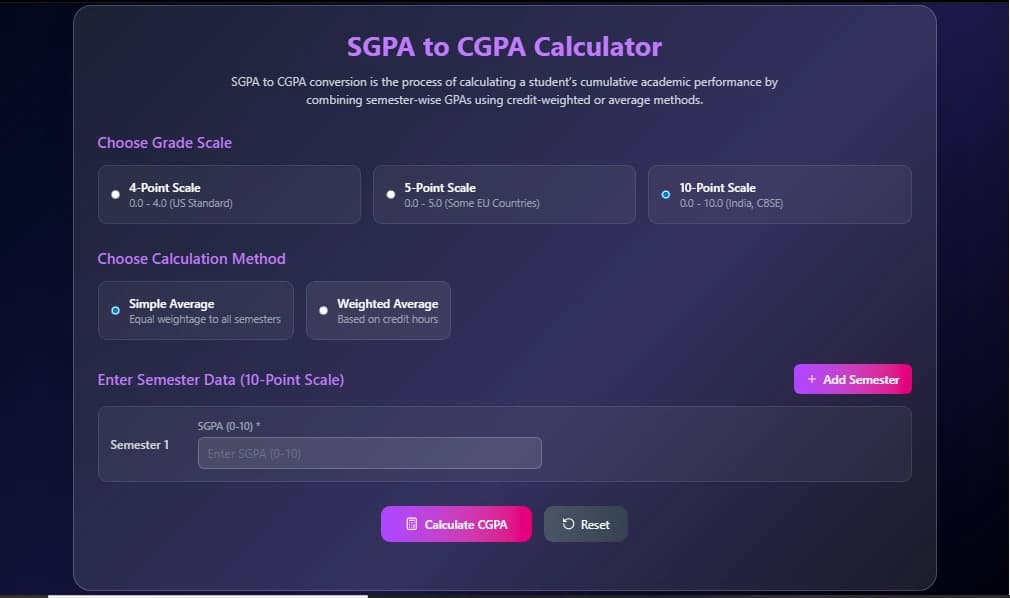
How to Use the SGPA to CGPA Calculator
1. Enter your semester details
Add your SGPA for each semester. If your university follows a credit-based system, enter the corresponding credit hours as well.
2. Choose the calculation method
Select how your CGPA should be calculated:
- Simple Average: All semesters are given equal weight. Best when each semester has the same total credits.
- Weighted Average: CGPA is calculated based on credit hours, giving more weight to semesters with higher credits.
3. Select your grading scale
Choose the grading system used by your institution, such as the 4.0 scale,10.0 scale, or your school’s specific grading system.
4. Calculate your CGPA instantly
Click the Calculate CGPA button to view your cumulative GPA and equivalent percentage instantly.
Understanding Different Grading Systems
Grading systems vary significantly across different educational institutions and countries. Understanding these variations is crucial for accurate CGPA calculation, especially if you're planning to transfer, apply for international programs, or work with global organizations that may interpret your grades differently.
10-Point Scale (India)
4-Point Scale (US/Canada)
Percentage System
Important Note on Scale Conversion
When converting between different grading scales, always use official conversion charts provided by your institution or the receiving organization. Approximate conversions may not be accurate for official purposes like transcripts, applications, or employment verification. Some universities provide official conversion services for international applications.
Comprehensive Step-by-Step Calculation Process
Accurate CGPA calculation requires systematic approach and attention to detail. Whether you're calculating for the first time or verifying existing calculations, following a structured process ensures accuracy and helps you understand the impact of each semester on your overall academic performance.
Method 1: Credit-Weighted Calculation
This method accounts for varying credit distributions across semesters, providing the most accurate representation of your academic performance. It's essential when semesters have different numbers of courses or credit hours.
- 1Data Collection: Gather SGPA and credit information for each completed semester from official transcripts
- 2Credit Point Calculation: Multiply each semester's SGPA by its respective total credits
- 3Sum Credit Points: Add all credit points from all completed semesters
- 4Sum Total Credits: Add total credits from all completed semesters
- 5Calculate CGPA: Divide total credit points by total credits and round to appropriate decimal places
Method 2: Simple Average (Equal Credits)
Use this method only when all semesters have identical credit distributions. While simpler, it's less accurate if there are variations in semester credit loads, which is common in many degree programs.
- 1List SGPAs: Write down SGPA for each completed semester in chronological order
- 2Verify Equal Credits: Confirm that all semesters have identical credit distributions
- 3Sum SGPAs: Add all SGPA values together for a total sum
- 4Calculate Average: Divide sum by number of semesters
- 5Round Result: Round to appropriate decimal places (typically 2 decimal places)
Pro Tips for Accurate Calculations
- • Always use official transcript data rather than memory or informal records
- • Double-check credit values, as some courses may have different credit weights
- • Include all attempted courses, including those you may have repeated
- • Keep detailed records of your calculations for future reference
- • Verify your university's specific rounding policies and grade point assignments
Detailed Practical Examples
Learning through examples is one of the most effective ways to master SGPA to CGPA conversion. These comprehensive examples demonstrate real-world scenarios you might encounter, including different credit distributions, varying semester lengths, and common calculation challenges. Each example includes detailed step-by-step breakdowns to help you understand the reasoning behind each calculation.
Example 1: Credit-Weighted Calculation with Varying Credits
This example demonstrates the most common scenario where different semesters have varying credit distributions. This situation typically occurs due to different numbers of courses, laboratory components, or project work across semesters.
| Semester | SGPA | Credits | Credit Points (SGPA × Credits) |
|---|---|---|---|
| Semester 1 | 8.5 | 24 | 8.5 × 24 = 204 |
| Semester 2 | 7.8 | 26 | 7.8 × 26 = 202.8 |
| Semester 3 | 9.2 | 22 | 9.2 × 22 = 202.4 |
| Semester 4 | 8.1 | 25 | 8.1 × 25 = 202.5 |
| Total | - | 97 | 811.7 |
Step-by-step calculation:
1. Total Credit Points = 204 + 202.8 + 202.4 + 202.5 = 811.7
2. Total Credits = 24 + 26 + 22 + 25 = 97
3. CGPA = 811.7 ÷ 97 = 8.37
Final CGPA = 8.37
Analysis: Notice how Semester 3 has the highest SGPA (9.2) but contributes less to the overall CGPA due to lower credits (22). This demonstrates why credit-weighted calculation is more accurate than simple averaging.
Example 2: Equal Credits Calculation
This example shows a scenario where all semesters have identical credit distributions, allowing for the simpler average calculation method. This is common in highly structured programs with consistent course loads.
| Semester | SGPA | Credits | Performance Level |
|---|---|---|---|
| Semester 1 | 7.9 | 24 | Good |
| Semester 2 | 8.3 | 24 | Very Good |
| Semester 3 | 8.7 | 24 | Very Good |
| Semester 4 | 8.1 | 24 | Very Good |
Simple Average Calculation:
CGPA = (7.9 + 8.3 + 8.7 + 8.1) ÷ 4
CGPA = 33.0 ÷ 4
CGPA = 8.25
Final CGPA = 8.25
Trend Analysis: This student shows consistent improvement from Semester 1 to 3, with a slight dip in Semester 4. The overall CGPA of 8.25 reflects strong academic performance with room for improvement.
Example 3: Complex Scenario with Course Retakes
This realistic example includes a failed course that was later repeated, demonstrating how grade replacement policies affect CGPA calculation. Different universities handle this differently.
| Semester | SGPA | Credits | Credit Points | Notes |
|---|---|---|---|---|
| Semester 1 | 8.2 | 24 | 196.8 | Normal semester |
| Semester 2 | 6.8 | 24 | 163.2 | Failed one subject |
| Semester 3 | 8.5 | 27 | 229.5 | Retook failed subject |
| Semester 4 | 8.9 | 24 | 213.6 | Strong recovery |
| Total | - | 99 | 803.1 | - |
Calculation with Grade Replacement:
Total Credit Points = 803.1
Total Credits = 99 (including retaken course)
CGPA = 803.1 ÷ 99 = 8.11
Final CGPA = 8.11
Online SGPA to CGPA Calculators
While understanding manual calculation is crucial, online calculators can save time and reduce errors, especially when dealing with multiple semesters or complex credit structures. However, choosing the right calculator and using it correctly is essential for accurate results that you can rely on for important applications.
Benefits of Online Calculators
- Accuracy: Eliminates manual calculation errors and reduces the risk of computational mistakes
- Speed: Provides instant results, saving hours of manual calculation time
- Multiple Formats: Supports various grading systems and university-specific requirements
- User-Friendly: Simple interface designed for easy data entry and result interpretation
- Free Access: Most calculators are available at no cost with comprehensive features
Key Features to Look For
- Multiple Grading Systems: Support for 4-point, 10-point, and percentage-based scales
- Credit Weighting: Ability to input different credit values for accurate weighted calculations
- Result Export: Option to save, print, or share calculation results
- Mobile Compatibility: Responsive design that works well on smartphones and tablets
- Batch Processing: Calculate multiple semesters and scenarios simultaneously
Calculator Selection Guidelines
When choosing an online calculator, prioritize those that allow you to specify your university's exact grading system. Generic calculators may use different conversion ratios or rounding rules that don't match your institution's policies.
Always cross-verify calculator results with manual calculations for important applications like graduate school admissions or scholarship applications. Keep documentation of your calculation methods for future reference.
Advanced Tips for Accurate Calculation
Mastering CGPA calculation goes beyond understanding basic formulas. Experienced students develop systematic approaches that ensure accuracy, maintain detailed records, and help them make strategic academic decisions. These advanced tips come from common student experiences and academic counselor recommendations.
Best Practices for Accuracy
- Use Official Transcripts: Always base calculations on official documents rather than personal records or memory
- Verify Credit Hours: Double-check credit values for each course, as some may have non-standard weightings
- Maintain Consistency: Use the same grading scale throughout all calculations to avoid conversion errors
- Document Everything: Keep detailed records of all calculations, including intermediate steps and assumptions
- Regular Updates: Recalculate CGPA after each semester to track progress and identify trends
Critical Mistakes to Avoid
- Scale Mixing: Never combine 4-point and 10-point scales without proper conversion
- Credit Neglect: Always use credit-weighted calculations when semesters have varying credit distributions
- Premature Rounding: Round only the final result to avoid cumulative rounding errors
- Incomplete Data: Include all attempted semesters, even those with lower performance
- Policy Ignorance: Understand your university's specific policies for grade replacement and transfer credits
Record Keeping
Maintain a digital spreadsheet with semester-wise SGPA, credits, and CGPA calculations. Include formulas for automatic updates and backup your data regularly.
Verification Methods
Cross-check your calculations with multiple methods and online calculators. Consult academic advisors for verification of complex scenarios.
Strategic Planning
Use CGPA calculations for future planning by modeling different grade scenarios to understand what performance levels you need in upcoming semesters.
Strategic CGPA Improvement Techniques
Improving your CGPA requires a strategic approach that goes beyond just studying harder. Successful students understand that CGPA improvement is about working smarter, making strategic course choices, and implementing systematic study approaches that yield consistent results over time.
Short-term Strategies (1-2 Semesters)
- High-Credit Focus: Prioritize subjects with higher credit weights for maximum CGPA impact
- Course Selection: Balance challenging courses with those where you have natural strengths
- Study Group Formation: Join or create study groups for difficult subjects to share knowledge
- Office Hours Usage: Regularly attend professor office hours for clarification and guidance
Long-term Strategies (3+ Semesters)
- Skill Development: Build foundational skills in mathematics, writing, and critical thinking
- Time Management: Develop systematic study schedules and stick to consistent routines
- Resource Utilization: Take advantage of tutoring services, academic support centers, and peer mentoring
- Health Balance: Maintain physical and mental wellness for sustained academic performance
✨ Related Academic Tools
Enhance your academic planning with our comprehensive suite of smart calculators:
Conclusion
Understanding how to calculate and convert SGPA to CGPA is essential for every student's academic success. Whether you're tracking your progress, applying for opportunities, or planning your academic future, accurate CGPA calculation provides the foundation for informed decision-making. This comprehensive guide has equipped you with the knowledge, tools, and strategies needed to master these calculations.
Regular monitoring of your CGPA helps maintain academic standards, identify areas for improvement, and ensure you meet requirements for various opportunities. Use the methods and examples provided in this guide to confidently calculate your CGPA and make strategic academic decisions that align with your career goals.
Remember that while CGPA is important, it's just one component of your academic profile. Combine strong academic performance with practical skills, internships, projects, and leadership experience for the best career prospects. Your academic journey is unique, and understanding these calculations empowers you to make the most of every opportunity.