Your Grade Point Average (GPA) is more than just a number on your transcript—it’s a key measure of your academic performance that can impact scholarships, program admissions, and future career opportunities. This University of Toronto GPA tool is designed to provide students with the most accurate results using 2026 standards.
At the University of Toronto (UofT), maintaining a strong GPA is essential. Whether you are searching for a u of t gpa calculator for Arts & Science or a uoft grade calculator for specific courses, knowing your uoft gpa is the first step toward academic success.
If you are a student at the Mississauga campus, you may want to use our dedicated UTM CGPA Calculator. We also support utsg gpa calculator and utsc gpa calculator needs for students across all campuses.
The University of Toronto primarily uses a standardized uoft 4.0 scale, converting letter grades into numerical values weighted by course credits. In this guide, we’ll show you how to calculate gpa uoft accurately.
Whether you’re aiming for scholarships, medical school, or Law School admissions, mastering the uoft grading system and using a reliable University of Toronto GPA calculator will help you stay on track.
Credit Weighting at UofT (0.5 vs 1.0 Courses)
One of the most common reasons students miscalculate their GPA at the University of Toronto is misunderstanding credit weighting. At UofT, your GPA is not a simple average of grades — it is weighted by course credits.
What 0.5 and 1.0 Credits Mean at UofT
- 0.5 credit courses are typically one-semester courses
- 1.0 credit courses usually span the full academic year
- A 1.0 credit course carries twice the weight of a 0.5 credit course in GPA calculation
How Credit Weighting Affects GPA More Than Percentages
A lower grade in a 1.0 credit course can impact your GPA more than a higher grade in multiple 0.5 credit courses. This is why focusing only on percentages without considering credit value leads to inaccurate GPA estimates.
For example, a B in a 1.0 credit course affects your GPA more than an A in a 0.5 credit course.
Common Credit Weighting Mistakes Students Make
- Treating all courses as equal weight
- Averaging percentage grades instead of grade points
- Forgetting to double the impact of full-year courses
- Miscalculating GPA after adding or dropping courses
Using a UofT-specific GPA calculator automatically applies correct credit weighting and prevents these errors.
Academic Standing & Minimum GPA Requirements at UofT
Maintaining good academic standing at the University of Toronto is essential for continuing your studies, accessing funding, and avoiding academic penalties.
GPA Required for Good Academic Standing
Most UofT programs require a minimum cumulative GPA of 1.50 to remain in good academic standing. Competitive programs may require higher averages.
Academic Probation Thresholds
If your cumulative GPA falls below 1.50, you may be placed on academic probation and required to improve your GPA within a specific timeframe.
Suspension Risk and Recovery
Failure to meet probation conditions can result in academic suspension. Readmission is possible but often comes with GPA and course-load restrictions.
Faculty-Level GPA Variations
- Arts & Science: Standard GPA thresholds
- Engineering: Stricter progression requirements
- Rotman Commerce: Higher continuation benchmarks
Always confirm requirements with your specific faculty.
UofT Engineering GPA Scale & Special Weighting
The Faculty of Applied Science & Engineering at UofT follows the standard uoft engineering gpa scale, but academic standing is often assessed via the Weighted Sessional Average (WSA). If you need to calculate gpa uoft for engineering courses, remember that their system emphasizes consistency across year-long cohorts.
Engineering Academic Standing Boundaries
- Clear Standing: Sessional average of 60% or higher.
- Probation: Sessional average between 50% and 60%.
- Honours List: Sessional average of 79.5% or higher.
Honours at Graduation for Engineers
Unlike Arts & Science, Engineering awards "Honours" and "High Honours" based on cumulative performance:
- Honours: Cumulative GPA of 3.50+
- High Honours: Cumulative GPA of 3.75+
CR/NCR, LWD & Repeated Courses — GPA Impact
UofT offers several grading options that can significantly affect your GPA if used strategically — or harm it if misunderstood.
Do CR/NCR Courses Affect GPA?
- CR/NCR courses do not affect GPA
- NCR grants no credit
- CR/NCR may not count toward program requirements
- Overuse may raise graduate school concerns
LWD vs F: Which Is Better for GPA?
- LWD does not affect GPA
- F counts as 0.0 and significantly lowers GPA
How Repeated Courses Are Counted
When a course is repeated, UofT uses the higher grade in GPA calculations, although both attempts remain visible on the transcript.
Strategic Warnings Students Should Know
- CR/NCR may disqualify courses from program requirements
- Excessive LWDs may raise red flags
- Repeating many courses can delay graduation
What Is a Competitive GPA at University of Toronto?
Dean’s List GPA
Typically requires an annual GPA of 3.50 or higher, depending on faculty.
Competitive GPA for Graduate School
- 3.7 – 4.0: Highly competitive
- 3.3 – 3.6: Strong and acceptable
- Below 3.0: May limit options for WES credential evaluation
How UofT GPAs Are Viewed Externally
UofT’s 4.0 GPA scale is widely respected, especially when supported by rigorous coursework.
GPA Planning With a Calculator (What-If Scenarios)
- Estimate GPA before final grades are released
- Calculate how many A’s are needed to reach a target GPA
- Plan GPA recovery after a poor semester
- Optimize final-year GPA impact before graduation
The Official UofT GPA Scale
What GPA scale does UofT use?
The University of Toronto uses a standardized 4.0 scale for all undergraduate programs across its three campuses (UTSG, UTM, UTSC). This scale converts letter grades into specific grade point values to calculate your sessional and cumulative average.
Is UofT GPA out of 4.0?
Yes, the UofT GPA is calculated out of 4.0. An A+ or A receives 4.0 grade points, while lower grades receive proportionally less. Understanding these values is crucial for meeting the minimum GPA required for UofT admission.
The University of Toronto uses a standardized uoft grade scale across most of its faculties. Below is the complete uoft grading scale, showing the relationship between letter grades, grade point values, percentage ranges, and performance descriptions. Understanding this uoft gpa scale is crucial for any student planning their academic journey.
Important Note: This grading scale is based on official UofT policy. Always verify specific requirements with your faculty or program advisor.
| Letter Grade | Grade Point | Percentage | Description |
|---|---|---|---|
| A+ | 4.0 | 90-100% | Excellent |
| A | 4.0 | 85-89% | Excellent |
| A- | 3.7 | 80-84% | Very Good |
| B+ | 3.3 | 77-79% | Good |
| B | 3.0 | 73-76% | Good |
| B- | 2.7 | 70-72% | Satisfactory |
| C+ | 2.3 | 67-69% | Adequate |
| C | 2.0 | 63-66% | Adequate |
| C- | 1.7 | 60-62% | Marginal |
| D+ | 1.3 | 57-59% | Marginal |
| D | 1.0 | 53-56% | Minimal |
| D- | 0.7 | 50-52% | Minimal |
| F | 0.0 | 0-49% | Fail |
What is a good GPA at UofT?
A "good" GPA depends on your goals (graduate school, internships, or graduation), but generally follows these benchmarks at the University of Toronto:
3.7 - 4.0 (Excellent): Highly competitive. This puts you on the Dean's List and makes you a top candidate for law school, med school, and elite master's programs.
3.3 - 3.6 (Very Good): Strong performance. You are above the average student and will be competitive for most graduate funding and academic honors.
3.0 - 3.2 (Good): Respectable standing. You meet the requirements for major programs and maintain a solid academic record.
Below 2.0 (Low): Risky standing. A cumulative GPA below 1.50 will eventually trigger academic probation.
UofT Percentage to GPA Conversion Table
Many students search for a quick way to map their numerical marks to the 4.0 scale. This uoft gpa to percentage guide provides the official boundaries used by the university. Whether you need gpa to percentage uoft conversions, uoft percentage to gpa charts, or vice-versa, this table is your official reference for grade to gpa uoft mapping.
| Percentage Range | Letter Grade | Grade Point |
|---|---|---|
| 85% – 100% | A/A+ | 4.0 |
| 80% – 84% | A- | 3.7 |
| 77% – 79% | B+ | 3.3 |
| 73% – 76% | B | 3.0 |
| 70% – 72% | B- | 2.7 |
| 60% – 66% | C/C- | 1.7 – 2.0 |
How to Calculate Your UofT GPA: Step-by-Step Guide
Calculating your GPA using a uoft gpa calc or even if you search for uoft gpa calcualtor (a common typo) might seem complicated at first, but once you understand the process, it becomes straightforward.
UofT GPA Meanings: Decode Your Grades (3.0, 3.7, 4.0)
When students search for "3.0 gpa uoft" or "3.6 gpa uoft", they are looking for the context behind their academic performance. Here is how your UofT grade point average translates to real-world standing, including what a b+ gpa uoft means for your transcript:
3.7 – 4.0 (A- to A+)
Excellent standing. This is the range for Dean's List eligibility and competitive graduate school admissions. A 4.0 GPA at UofT is generally 85%+ in every course.
3.0 – 3.3 (B to B+)
Good academic performance. A 3.0 gpa uoft means you are maintaining a solid "B" average, meeting the requirements for most honors and major programs.
2.5 – 2.7 (B- to C+)
Satisfactory standing. While meeting the minimum for progression, a 2.5 gpa uoft may require improvement for competitive post-grad options.
Below 2.0 (C- to F)
At risk. Cumulative GPAs under 1.50 trigger academic probation at the University of Toronto. Use our final grade calculator uoft to plan your recovery.
UofT 4.0 Scale vs. Percentage System
The UofT 4.0 scale is more granular than a simple percentage. Because a 3.7 is a "A-" and a 4.0 is a "A", your sessional average can change significantly even if your raw percentages stay in the high 80s. This is why using a dedicated UofT scale calculator is more accurate than manual estimates.
UofT GPA Formula & Step-by-Step Calculation
GPA = (Sum of Grade Points × Credits) ÷ Total Credits
Calculation Steps
Step 1: Gather Course Information
Collect the letter grade and credit value for each course. Most UofT courses are 0.5 or 1.0 credits.
Step 2: Convert Grades to Points
Use the grading scale table to convert each letter grade to its grade point value.
Step 3: Multiply by Credits
For each course, multiply the grade point value by the number of credits.
Step 4: Sum and Divide
Add all grade points, then divide by total credits to get your GPA.
Example Calculation
| Course | Grade | Credits | Points | Earned |
|---|---|---|---|---|
| CSC108 | A- | 0.5 | 3.7 | 1.85 |
| MAT137 | B+ | 1 | 3.3 | 3.30 |
| PSY100 | A | 0.5 | 4 | 2.00 |
| ECO101 | B | 0.5 | 3 | 1.50 |
| Totals: | 2.5 | 8.65 | ||
Final Calculation:
Total Points: 8.65
Total Credits: 2.5
GPA = 8.65 ÷ 2.5 =3.46
This GPA of 3.46 represents a strong B+ average for a first semester at UofT.
Using a UofT GPA Calculator
While manual calculation helps you understand the process, using a dedicated GPA calculator saves time and eliminates errors. Modern calculators can track your current GPA, plan future semesters, and explore what-if scenarios.
Benefits of Using a GPA Calculator
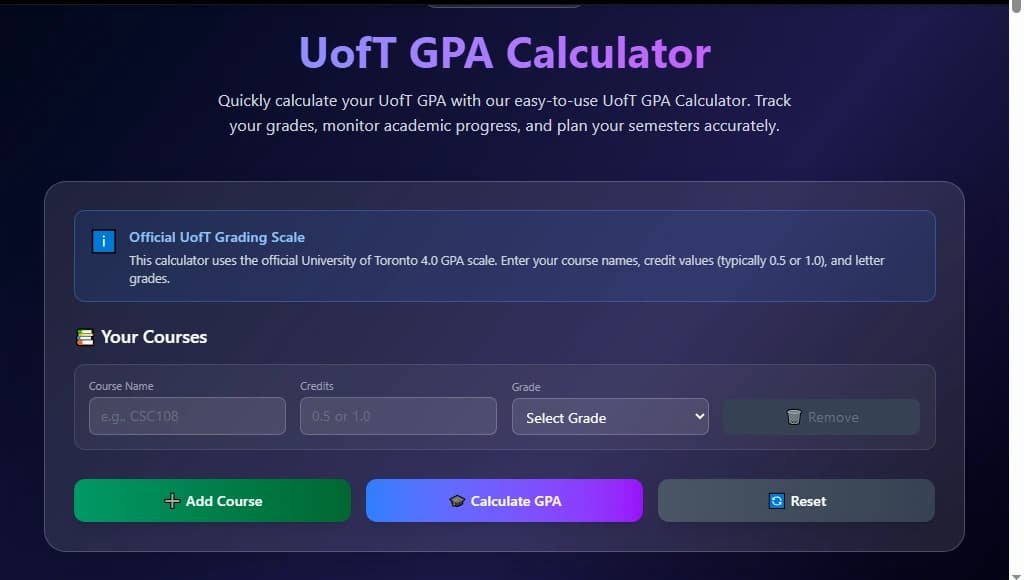
How to Use a UofT GPA Calculator
- 1.Enter your course names or codes
- 2.Input credit hours (typically 0.5 or 1.0)
- 3.Select your letter grade from the dropdown
- 4.View your GPA and academic standing instantly
Strategies to Improve Your UofT GPA
Strategic Course Selection
Balance challenging courses with electives you are passionate about. Do not overload yourself with difficult courses in one semester. Consider CR/NCR options strategically for courses outside your program requirements.
Utilize Academic Resources
Take advantage of UofT's support system: attend office hours, join study groups, use Writing Centers, and visit the Academic Success Centre. These resources exist to help you succeed.
Time Management Excellence
Create a realistic study schedule. Start assignments early, break large projects into manageable tasks, and prioritize consistent effort over last-minute cramming.
Consider Course Repeats
If you receive a poor grade, you can retake the course. UofT will use the higher grade in your GPA calculation, though both grades remain on your transcript.
Knowing your GPA is essential, but what does it actually mean for your future? Different GPA ranges carry different implications for your academic standing and your eligibility for UofT admission.
Conclusion
Understanding the UofT GPA scale and how to calculate your grades is key to achieving academic success at one of Canada’s most prestigious universities. Whether your goal is making the Dean’s List, preparing for graduate school, or simply maintaining good academic standing, knowing your GPA empowers you to make informed academic decisions.
GPA calculators are invaluable tools for this process. They allow you to:
- Instantly calculate your current GPA using official grade point values and course credit weightings.
- Plan future semesters by exploring “what-if” scenarios, such as how different grades will impact your cumulative GPA.
- Identify areas for improvement early, helping you adjust course loads or study strategies before the semester ends.
By using a UofT GPA calculator, you can set realistic goals, monitor your progress each semester, and take proactive steps to optimize your academic performance. Your GPA is more than just a number—it’s a roadmap for your university journey, and a calculator makes that roadmap clear and actionable.
Expert Admission Guides
FAQs – UofT GPA Calculator
1. What is the UofT GPA Calculator?
The University of Toronto GPA tool is an online resource that helps students accurately calculate their semester or cumulative average based on official university grading policies.
2. How do I calculate GPA at UofT?
To determine your standing, multiply each course’s grade point by its credit value, add all quality points, and divide by total credits attempted. This GPA tool for UofT automates this process instantly.
3. Does the GPA Calculator UofT follow the official UofT grading scale?
Yes. A reliable University of Toronto GPA calculator follows the official weighting method, including distinctions between grades like A+, A, and A- on the correct 4.0 scale.
4. Can I calculate both semester and cumulative GPA using the UofT GPA Calculator?
Absolutely. Most UofT GPA calculators allow you to calculate both semester GPA and cumulative GPA by entering courses from one or multiple terms, making long-term academic planning easier.
5. Do Pass/Fail or CR/NCR courses affect UofT GPA calculation?
No. Courses graded as CR/NCR or Pass/Fail appear on your transcript but are excluded from UofT GPA calculation. A proper GPA Calculator UofT automatically ignores these courses when computing GPA.
6. How accurate is an online GPA UofT calculator?
An accurate GPA UofT calculator follows the official formula used by the University of Toronto. When you enter correct grades and credit values, the results closely match your official academic record.
7. Can I use the UofT GPA Calculator for graduate or undergraduate programs?
Yes. The UofT GPA Calculator can be used by both undergraduate and graduate students, as long as the grading scale and credit system align with UofT standards.
8. Why should I use a GPA Calculator UofT instead of calculating manually?
Manual GPA calculations are time-consuming and prone to mistakes. A GPA Calculator UofT saves time, ensures accuracy, helps with GPA planning, and allows you to test grade scenarios for scholarships, honors, or academic standing.
9. What is the GPA for Distinction at UofT?
Graduating with Distinction requires a cumulative GPA of 3.20 to 3.49. For High Distinction, students must maintain a cumulative GPA of 3.50 or higher.
10. How do I convert percentage to GPA at UofT?
You can convert your UofT percentage using the official table: 85%+ is 4.0, 80-84% is 3.7, 77-79% is 3.3, 73-76% is 3.0, and 70-72% is 2.7. Our calculator automates this conversion process.