Trump’s 2026 Student Loan Overhaul: New Repayment Rules Explained
With over 40 million Americans holding federal student loans totaling more than $1.7 trillion, any overhaul to repayment rules draws intense attention. As of May 2026, the Trump administration has finalized sweeping changes through the One Big Beautiful Bill Act (OBBBA), signed in July 2025, and a landmark Department of Education rule released on April 30, 2026.
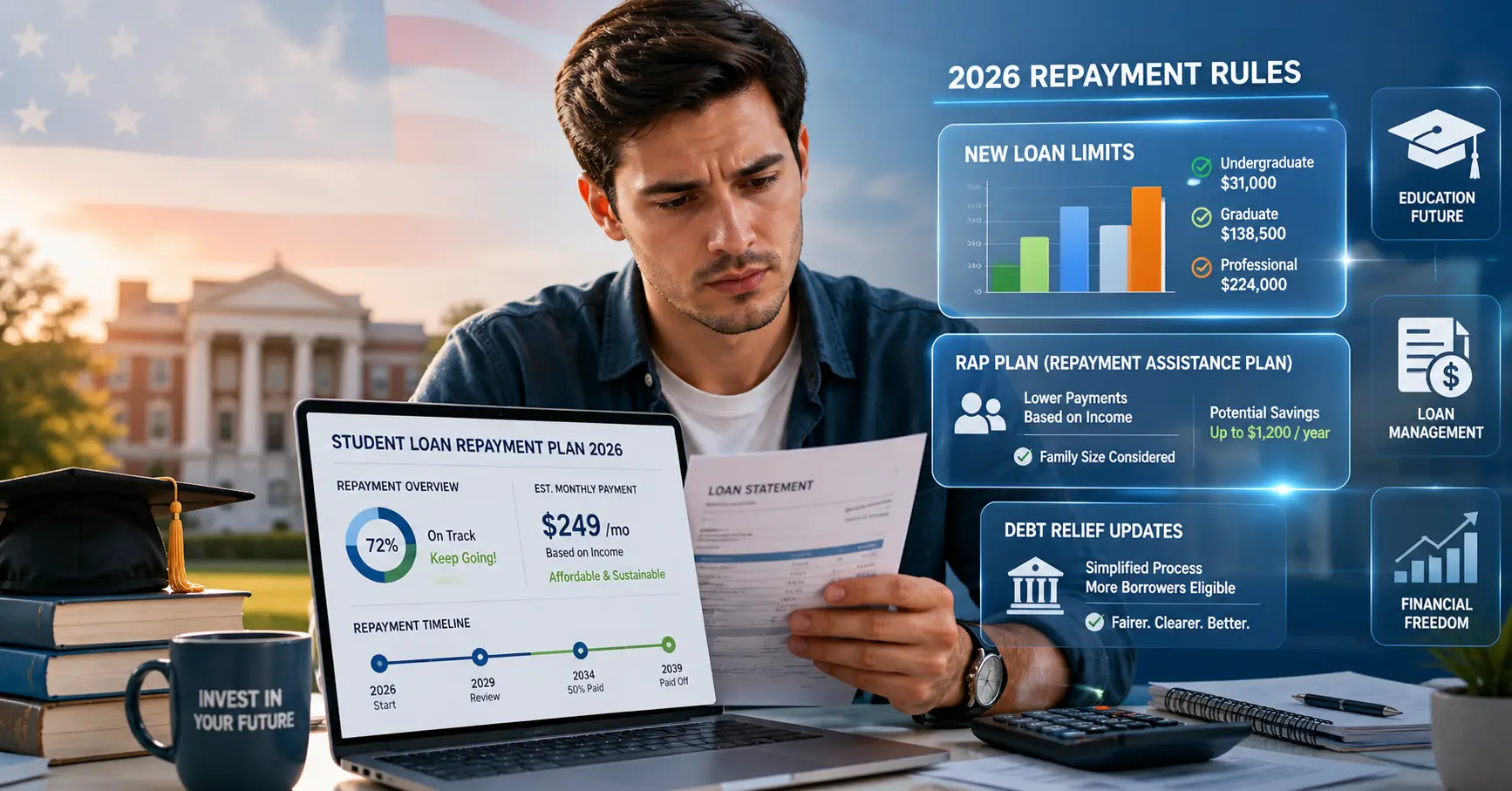
These reforms aim to simplify a confusing patchwork of repayment plans, curb excessive borrowing (especially for graduate degrees), and shift the system toward greater accountability. Most provisions take effect July 1, 2026. Whether you're a current borrower or planning to borrow soon, understanding these new student loan repayment rules is essential.
Whether you're a current borrower, recent graduate, or planning to borrow soon, understanding these Trump student loan repayment rules is essential. This guide breaks down the latest details, compares old and new systems, and offers practical steps.
What This Guide Covers
- Background: Simplified Streamlining
- OBBBA: The Foundation of Change
- Major Changes Starting July 2026
- RAP: The New Income-Driven Option
- New Tiered Standard Repayment Plan
- Impact on Graduate Borrowing Limits
Background: From Complexity to Streamlining
The federal student loan system has long been criticized for its maze of income-driven repayment (IDR) plans—like PAYE, ICR, IBR, and the Biden-era SAVE plan—each with different payment formulas, forgiveness timelines (often 20-25 years), and eligibility rules.
The SAVE plan, in particular, faced repeated legal challenges and was effectively ended via a settlement with Missouri, with the Trump administration directing 7.5 million enrollees to switch plans. The Trump administration's approach emphasizes personal responsibility ("if you take out a loan, you must pay it back"), reduced taxpayer exposure, and incentives for colleges to control costs. The final rule announced April 30, 2026, implements parts of the OBBBA by creating a new income-driven option, a tiered standard plan, borrowing caps, and protections against balance growth.
The One Big Beautiful Bill Act (OBBBA)
Signed on July 4, 2025, the OBBBA represents the most significant rewrite of federal student aid in decades. Its goals include lowering college costs, simplifying repayment, and protecting taxpayers—projected to save hundreds of billions by curbing "illegal" forgiveness and unchecked borrowing.
Key pillars relevant to repayment:
- Streamlining repayment options into two clear paths.
- Introducing the Repayment Assistance Plan (RAP).
- New loan limits and elimination of unlimited Grad PLUS borrowing.
- Phasing out several legacy IDR plans to reduce confusion.
Major Changes Starting July 1, 2026
For new loans disbursed on or after July 1, 2026, borrowers will have only two repayment choices:
1. New Tiered Standard Plan
Replaces old standard and graduated plans with fixed payments based on total debt volume.
2. Repayment Assistance Plan (RAP)
The sole remaining income-driven option for new borrowers, designed for affordability.
Legacy plans like SAVE, PAYE, and ICR are being phased out. SAVE is already winding down, with affected borrowers given at least 90 days (starting notifications around July 2026) to switch. PAYE and ICR remain temporarily available for pre-2026 loans but will sunset by July 1, 2028. The existing Income-Based Repayment (IBR) plan continues to apply to qualifying pre-2026 loans.
Elimination of negative amortization is a highlighted benefit: RAP and the new standard plan are designed to prevent balances from growing due to unpaid interest in many cases.
The Repayment Assistance Plan (RAP): Deep Dive
RAP replaces most IDR plans for new borrowers. According to Department guidance and analyses, the plan introduces several new mechanics:
Generally 1%–10% of adjusted gross income (AGI), scaled by income level and reduced by $50 per dependent. A $10 minimum monthly payment applies to very low earners (AGI ≤ $10k).
Remaining balance forgiven after 30 years of qualifying payments—longer than the 20-25 years common in prior IDR plans.
More predictable, affordable payments for lower earners; interest subsidies to help prevent balance growth; simpler structure.
Longer path to forgiveness may mean more total paid over time for some; once on RAP, switching back to standard may be restricted.
Example: A borrower earning $40,000 with dependents might see payments significantly lower than a standard 10-year plan but face a longer overall commitment. RAP aims to provide a safety net without the aggressive forgiveness criticized in SAVE. Experts note it raises payments for many compared to SAVE but offers stability.
The New Tiered Standard Repayment Plan
This replaces the old standard, graduated, and extended plans for new borrowers. Payments are fixed, like a mortgage, with term lengths varying by total debt:
- Smaller balances: Term lengths closer to 10 years.
- Larger balances: Term lengths extended up to 25 years.
The exact tiers depend on loan size, providing more breathing room for heavy borrowers than the traditional 10-year standard while keeping payments predictable. It suits those who prefer fixed amounts over income-based variability.
What About Existing Borrowers?
If you borrowed before July 1, 2026:
- You can often stay on your current plan temporarily (including certain IDR options until 2028).
- SAVE enrollees must switch; notifications are rolling out with 90-day windows.
- Consolidating or taking new loans after the date may push you into the new system.
- IBR remains an option for many legacy borrowers.
Current students or recent grads should review their servicer communications closely and consider acting before deadlines to preserve favorable terms where possible. Automatic placement into RAP may occur for those who don't choose.
New Borrowing Limits: Capping the Debt Spiral
One of the most impactful changes is the end of unlimited borrowing via Grad PLUS loans. Starting July 1, 2026:
Graduate Students
Annual limit around $20,500; lifetime cap $100,000 for most graduate programs.
Professional Degrees
Narrowed to 11 fields (Medicine, Law, etc.); Up to $200,000 aggregate in some cases.
Schools can set their own lower limits based on program value and graduate earnings outcomes. The final rule also ties program eligibility to graduate earnings and debt outcomes, pressuring institutions to control tuition and improve value. This addresses long-standing concerns about programs where debt far outpaces earning potential.
PSLF and Forgiveness Updates
Public Service Loan Forgiveness (PSLF) continues but faces tighter scrutiny. The administration has finalized rules allowing denial of eligibility for workers at organizations deemed to have a "substantial illegal purpose" (e.g., certain activities related to immigration or other policy flashpoints).
The "Tax Bomb" Warning
Forgiveness under IDR plans (except PSLF and some others) becomes taxable income again after 2025, potentially creating a "tax bomb" for large balances forgiven after 30 years on RAP.
Additionally, Parent PLUS loans have restricted access to IDR/RAP in the new system, making it more challenging for parents to lower their monthly commitments through income-based metrics.
Pros, Cons, and Borrower Impact
Potential Advantages
- • Simpler choices reduce confusion for new students.
- • Borrowing caps may slow tuition inflation over time.
- • Protections against negative amortization provide stability.
- • Encourages better financial planning before borrowing.
Potential Challenges
- • Longer forgiveness timelines (30 years on RAP).
- • Reduced flexibility for graduate students facing caps.
- • Transition uncertainty for millions exiting SAVE.
- • Possible shift toward high-interest private loans.
Action Steps for Borrowers in 2026
Log into StudentAid.gov immediately to check your loans and current servicer messages.
If on SAVE: Prepare to switch within your 90-day window—gather 2025 tax documents.
Review budgets: Model payments under RAP vs. standard using Department tools or calculators.
For prospective borrowers: Research program costs vs. expected earnings carefully due to new limits.
Seek help: Contact your servicer, nonprofit counselors, or financial advisors. Default collections are resuming.
Stay proactive—rules may see technical adjustments as implementation unfolds. For detailed economic impacts of these changes, you can review the Congressional Budget Office (CBO) education reports or our internal grade calculators.
Future Outlook & Conclusion
These Trump student loan repayment rules mark a philosophical shift toward accountability and simplicity. Implementation will unfold over 2026–2028, with potential legal challenges or tweaks. The emphasis on program value and taxpayer protection could influence higher education broadly.
The 2026 overhaul replaces complexity with two core plans, imposes borrowing discipline, and prioritizes repayment over expansive forgiveness. Stay proactive, understand your options, and treat student debt as a serious financial commitment. Informed decisions now will minimize stress as these rules take full effect.
Frequently Asked Questions
What is the Repayment Assistance Plan (RAP)?+
When do the new Trump student loan repayment rules start?+
How do the new borrowing caps work for graduate students?+
Will existing student loan borrowers be affected by the 2026 changes?+
Is student loan forgiveness still available in 2026?+
Stay Ahead of Academic Policy
Navigating education policy is as complex as managing your GPA. Use our tools to stay on track and plan your academic journey with confidence.